Bigfoot County, California: True Legends of the Redwood Curtain

Jake Wolf-Jensen
A man takes the stage.
He’s dressed for the summer heat: dark shorts, sandals, a t-shirt bearing the American flag. His thick black eyebrows stand out against his white hair and mustache. The banner behind him reads "WILLOW CREEK BIGFOOT DAZE" and, in smaller letters underneath, "Bigfoot Calling Contest."
He steps up to the microphone, takes a deep breath, and makes a noise unreplicable in writing. It’s a single, unbroken hoot, loud and clear, starting at a low register and climbing steadily for at least six full seconds. As the audience holds their applause, he caps this display of breath control with a shrill, catlike hiss.
The crowd goes wild, and I catch the unmistakable scent of high-quality sativa drifting through the pavilion.
Welcome to Humboldt County.
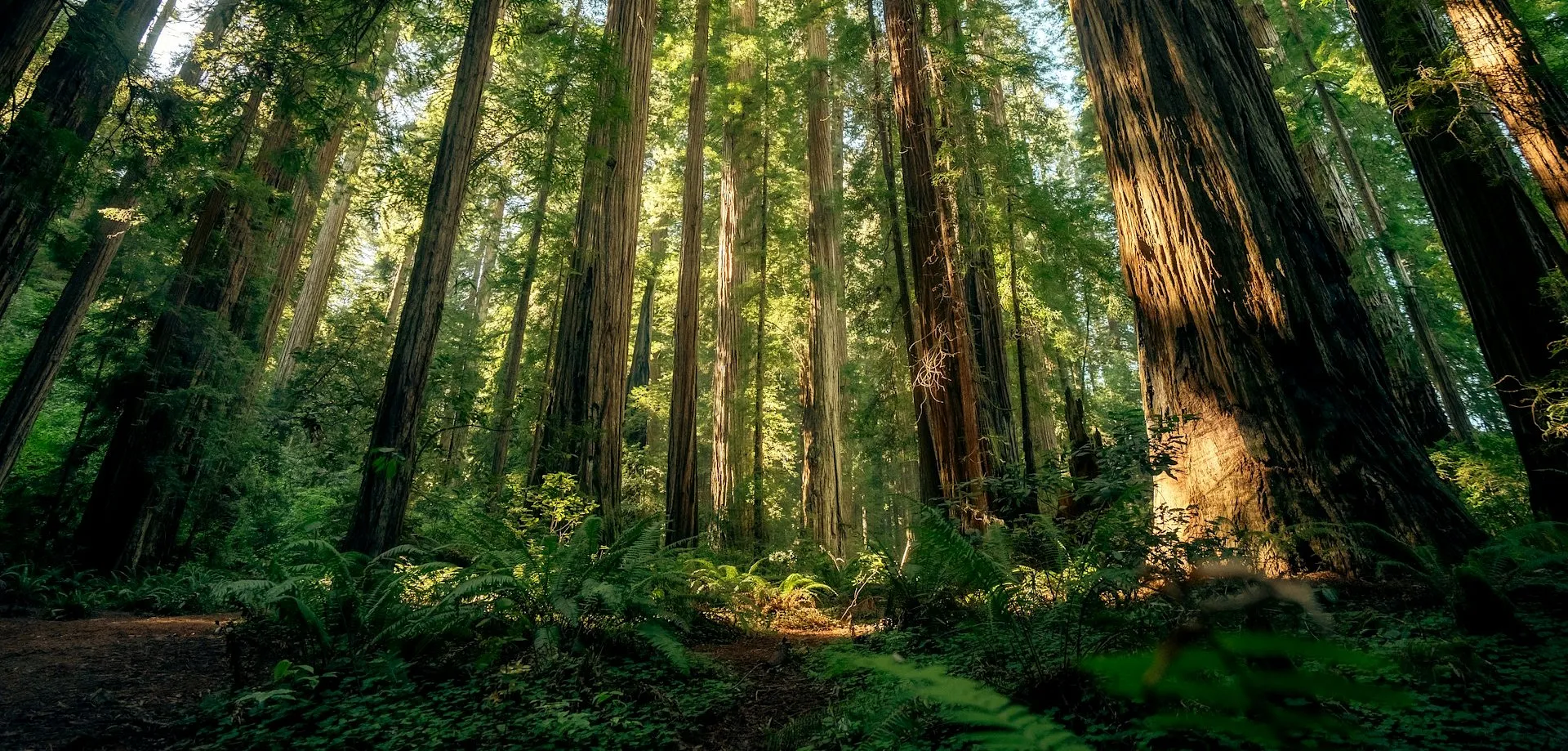
This place has always been a little… out there. Isolated in the redwood forests of Northern California, Humboldt's early mining and logging communities developed a reputation for rugged individualism that prevails to this day. In the 1970s, a post-hippie migration from San Francisco further shifted the local culture, infusing the existing blue-collar recalcitrance with a crunchier, more spiritual flavor (and kickstarting its now-famous cannabis industry).
It’s the kind of place where a DJ named lizzerd kween reads tarot live on air, and you don’t look twice at a man walking a turkey on a leash.
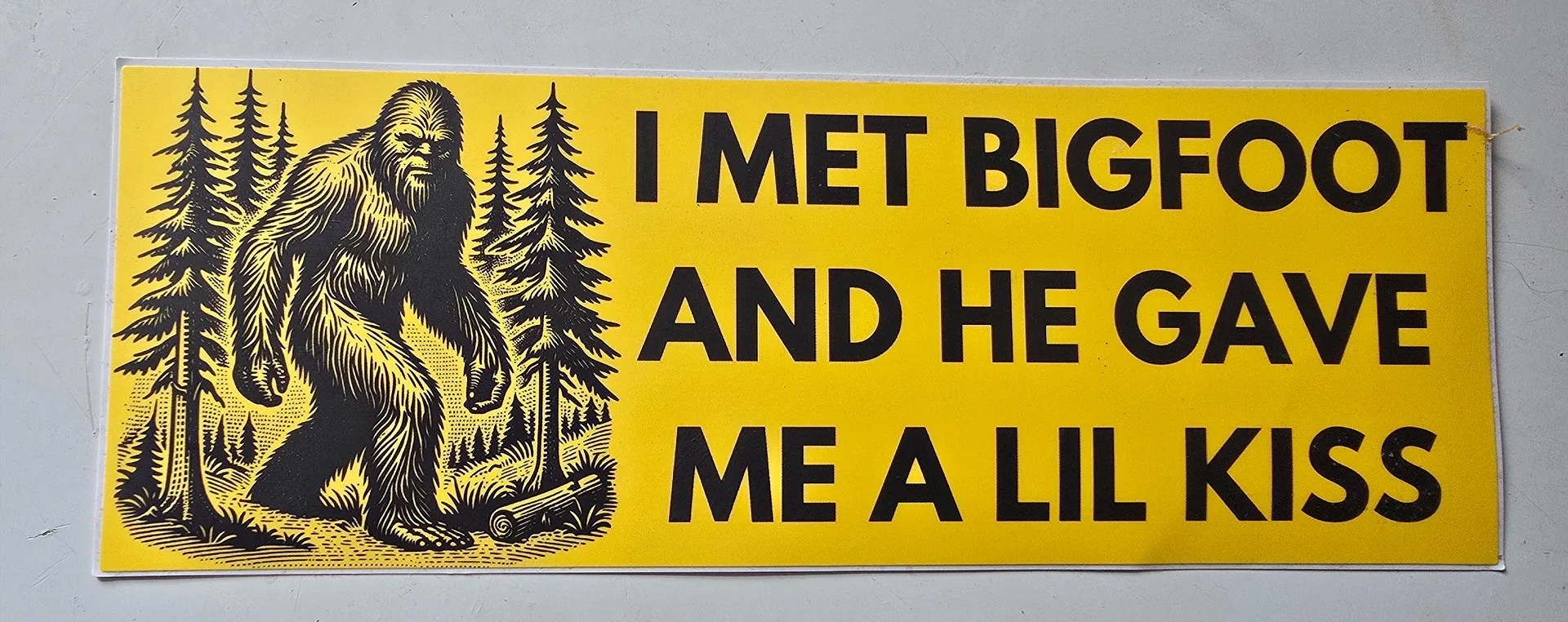
This vast, sparsely inhabited forest dotted with hippie enclaves is the perfect environment to birth a legend like Bigfoot. Sometimes heard, rarely seen, and only once caught on film, he’s become an enduring symbol of the community, appearing on signs, t-shirts, and bumper stickers all over the county. But despite supposedly haunting these woods for decades, Bigfoot remains frustratingly elusive. No specimen has ever been captured, no widely accepted evidence brought forward. Even the competitors at the Bigfoot calling contest can’t agree on what he sounds like.
Not bad for a 10-foot-tall humanoid covered in hair.
The contest’s second participant is a young man in his early 20s, possibly a student at the university. He approaches the mic with a barely suppressed smile.
He clears his throat, leans in… and then drops the punchline: “Hey, Bigfoot! C’mere!”
The joke draws a couple of weak chuckles from the crowd but otherwise falls flat, and the young man shrugs before exiting the stage. The host takes over the mic, giving him a slightly disapproving look.
“There’s one every year,” she says.
Indigenous American folklore is bursting with tales of hairy man-apes lurking in the woods, but the modern sasquatch story is a Humboldt original. It began in 1958, when a bulldozer operator named Jerry Crew made a call to the office of the Humboldt Times newspaper. He had discovered something strange at his logging camp in Six Rivers National Forest: 16-inch-long human footprints, sunk deep into the mud.
A reporter found that many of the other loggers had seen similar impressions near the site. “The workers have taken to calling the visitor 'Big Foot' because of the size of the prints,” he wrote, inadvertently coining a soon-to-be-famous handle. “Are the tracks a human hoax? Or, are they actual tracks of a huge but harmless wild-man, traveling through the wilderness?”
The Times article was picked up by the Associated Press the next day, introducing Bigfoot to a curious nation. Reports began to stream in from all over the country, but the most credible originated in Humboldt: the 1959 Bluff Creek tracks, the repeated Orleans sightings between '60 and '63, Al Hodgson’s footprint cast. And finally, seismically, there came the 1967 Patterson-Gimlin film.
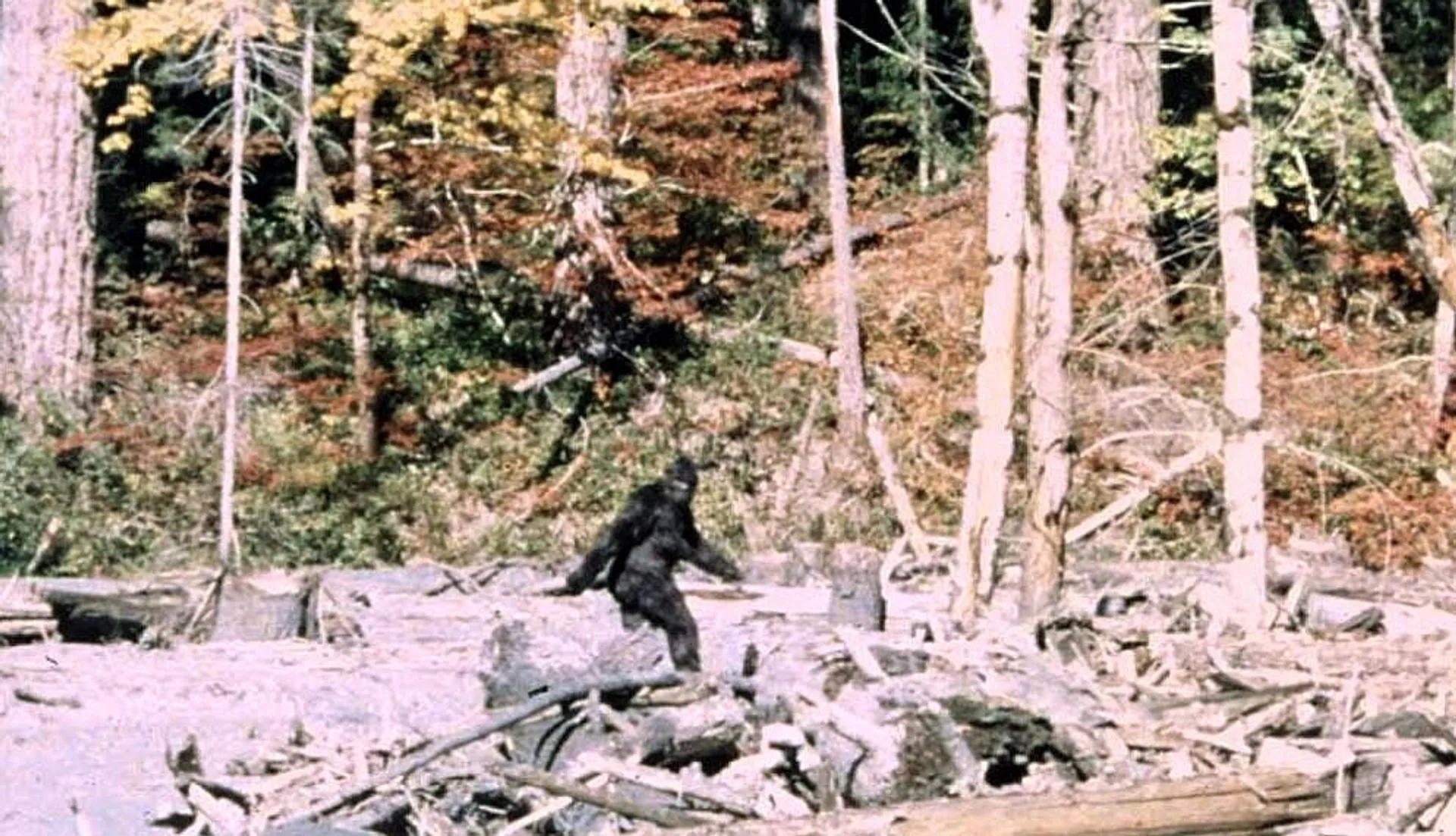
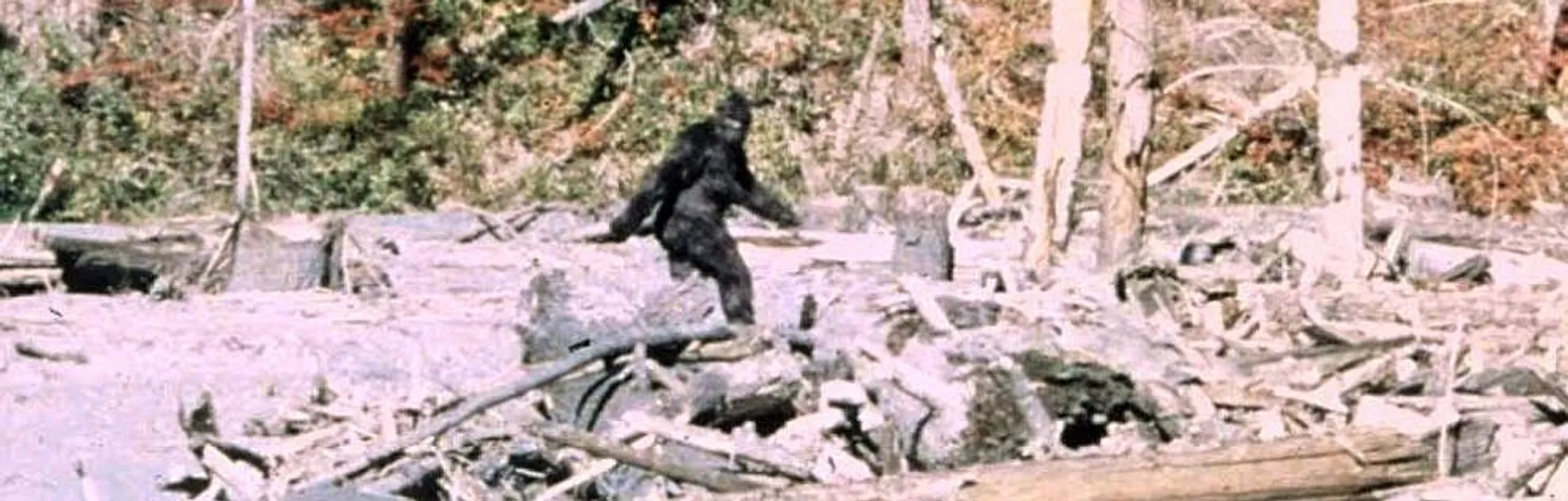
You’ve probably seen bits of this footage, shot by amateur researchers Roger Patterson and Robert Gimlin in the woods outside Willow Creek. Running about 59 seconds long, the film shows a hairy, ambling figure, its arms swinging as it shuffles across a dried-up riverbed. About halfway through, the creature turns to look back at the camera without breaking stride. Patterson would later describe its expression as “contempt and disgust.”
“You know how it is when the umpire tells you, ‘One more word and you're out of the game,’” he told one journalist. “That's the way it felt.”
The film remains the most plausible piece of evidence supporting Bigfoot’s existence. It’s never been properly disproven, and I have to admit, there’s something compelling about it. The footage doesn’t convince me, not really, but watching it does activate some especially credulous corner of my brain. What if, a voice says. What if it were true?
Can I really say it’s not?
After five competitors, the Bigfoot calling contest draws to a close. The man in the American flag shirt is crowned champion, while the jokester comes fourth, beating only a small child who was too nervous to step on stage.
As the crowd dissipates, I wander to a booth manned by a group of local experts called the Bluff Creek Project. Their research centers on the Patterson-Gimlin film, and they’re promoting a book about their quest to discover the exact spot where that footage was shot. It’s 615 pages long, self-published, and has surprisingly excellent ratings on Amazon.
None of these men are professional researchers. Their expertise comes from childhood fascinations and accounts passed down by the old guard of NorCal Bigfooters — Bob Gimlin, Al Hodgson, Bob Titmus. It’s a community bound by shared belief. Nobody wants to find out if Bigfoot exists; they want to prove what they already know to be true.
The Bluff Creek Project turns out to have some wide-ranging connections. They work closely with luminaries like Daniel Perez, publisher of the highly regarded Bigfoot Times, and James “Bobo” Fay, a cast member on Animal Planet’s Finding Bigfoot. Bobo is pretty much an honorary member of the BCP, I’m told. His name carries weight.
They’re also acquainted with Matt Moneymaker, creator of Finding Bigfoot and founder of the Bigfoot Field Researchers Organization. Unlike Bobo, Moneymaker is a controversial figure in the cryptozoology community. His late-night, sometimes drunken comments on /r/bigfoot are the stuff of legends, and his attention-grabbing persona draws suspicion from more serious-minded enthusiasts. The TV show impresses few true believers.
To his detractors, Moneymaker is a charlatan, a huckster using the community to chase fame and fortune. In this world, mistakes are understandable. Everyone falls for hoaxes now and again, and amateur researchers are bound to get things wrong. But to be cynical? To go sasquatch hunting without a pure and noble heart? Unforgivable.
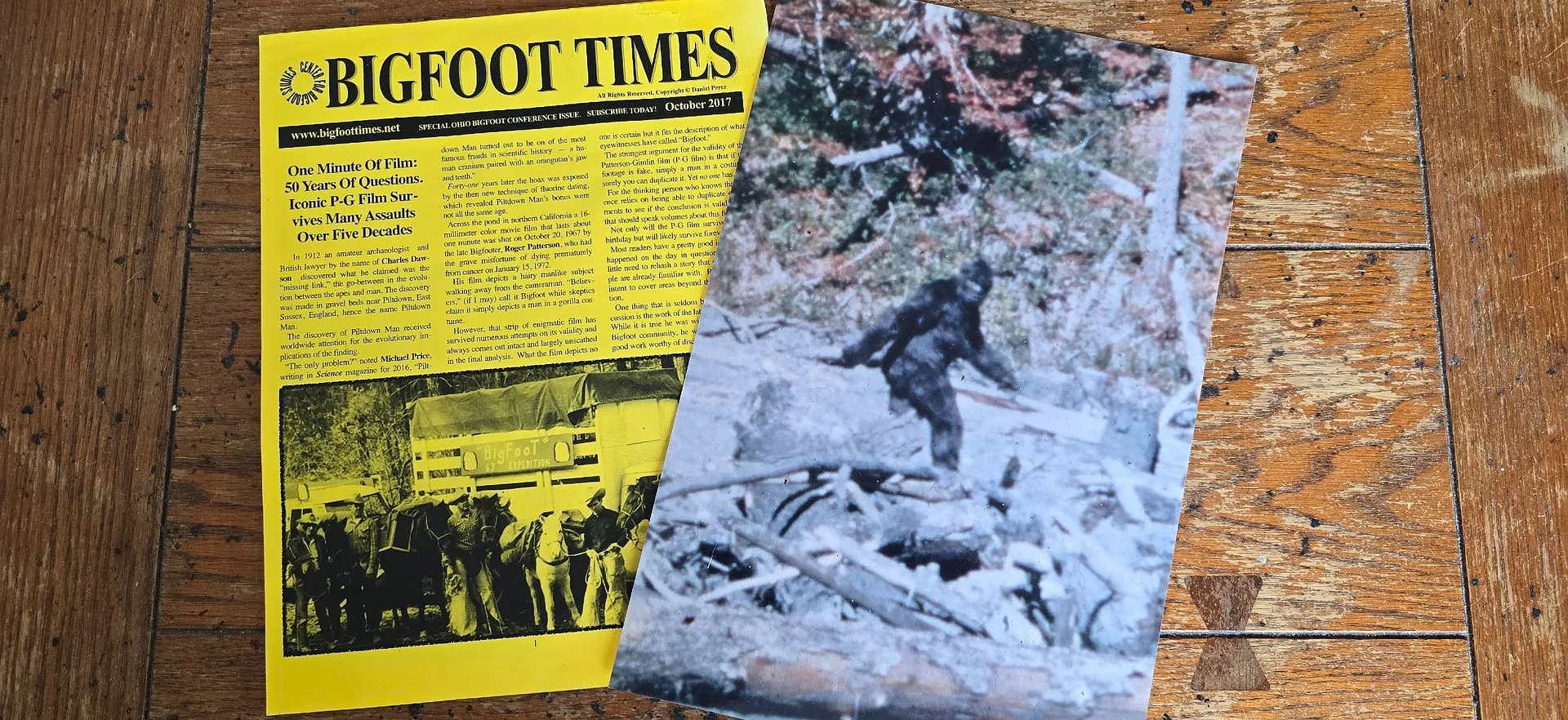
The BCP booth sells me an 8x12 print from the P-G film (frame #352, printed from the original 16mm negative!) and they throw in a free edition of the Bigfoot Times. On the back page, a bitter quote from the late Roger Patterson catches my eye: “No one believes us. We should have shot that thing. Then people would believe us.”
Of course, Patterson was a bit of a hustler too. He profited greatly from his sasquatch footage, spending the rest of his life touring and making paid appearances with it. He sold the distribution rights to anyone who would pay, often double-dipping and creating legal entanglements. After a falling out, he even hired an actor to impersonate Bob Gimlin at events, not wanting to jeopardize his revenue stream.
Look closer and you'll find plenty of evidence that casts doubt on the recording itself. Roger Patterson spent the summer of 1967 filming a Bigfoot-themed mockumentary film, one that would have required a costume. That costume may have been provided by a designer named Philip Morris, who claimed to have sold Patterson a gorilla suit earlier that year. And in 1998, Bob Heironimus, a crew member on the docudrama, announced that he was the figure seen in the P-G footage, having been hired by Patterson to create a hoax.
Still, Patterson escapes much of the scrutiny that dogs Matt Moneymaker. Bigfooters are quick to point out inconsistencies — Heironimus said the suit he wore was made of heavy horsehide, while Morris always used lightweight synthetic materials. But the biggest difference, I suspect, is that Finding Bigfoot is petty entertainment, and the Patterson-Gimlin film is something more.
It’s worth believing in.
After leaving the fairgrounds, I stroll down Willow Creek’s main thoroughfare, passing by the Bigfoot Motel, Bigfoot Cannabis Company, Bigfoot Steakhouse, Bigfoot’s Barbershop. You’ll see sasquatch merch in stores all over the county, but Willow Creek is especially shameless about commercializing the legend. I can’t really blame them; Humboldt’s median income is among the lowest in California, and the “green rush” that followed marijuana legalization has faded away. If redwood-seeking tourists would rather stop at the Bigfoot Motel than the Motel 6, you may as well take advantage.
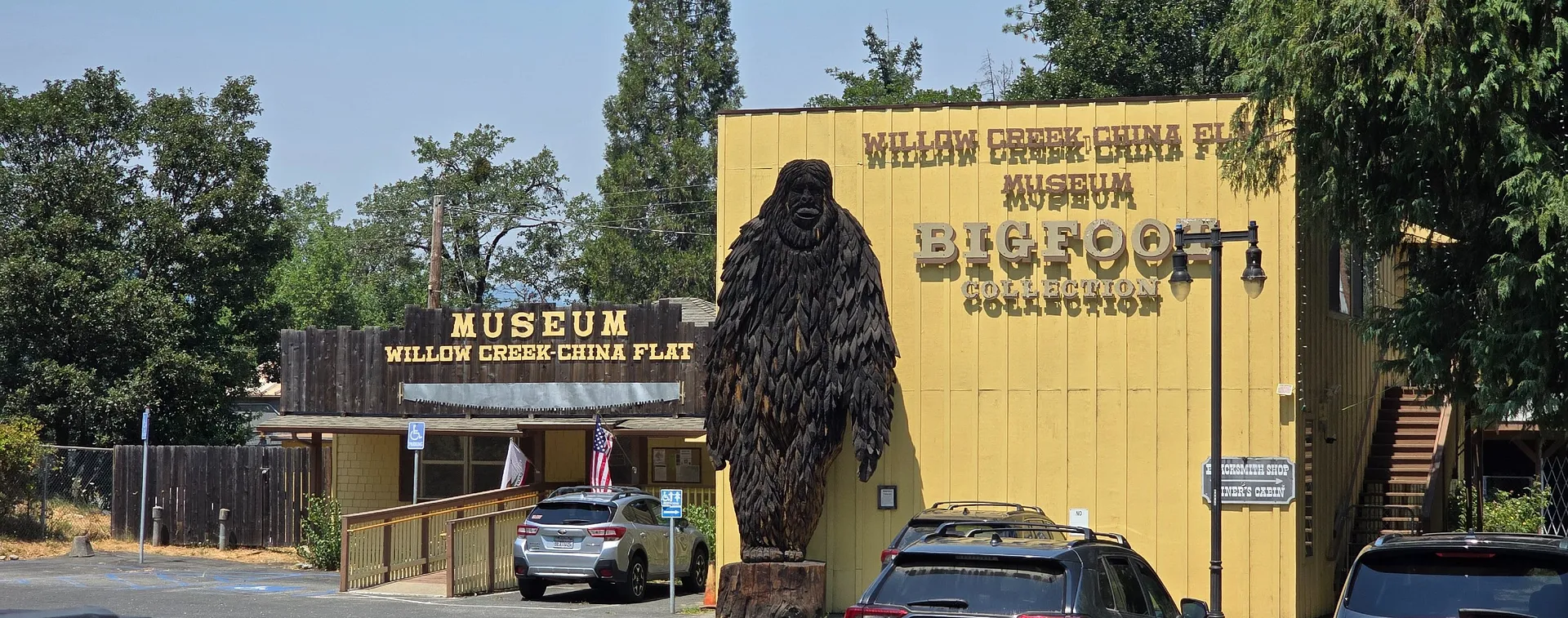
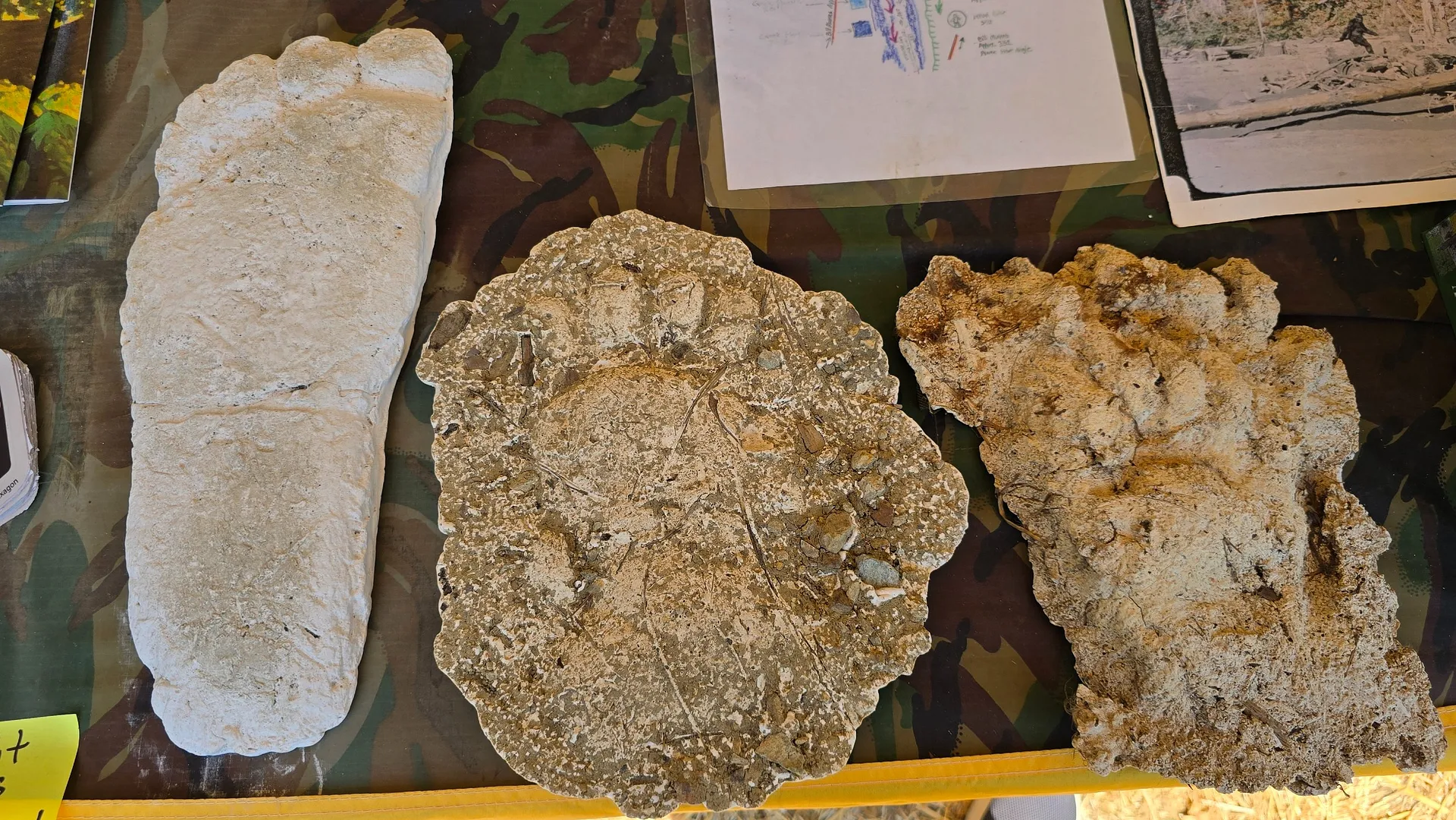
A short walk brings me to my destination: the Willow Creek-China Flats Museum & Bigfoot Collection. The collection, donated by investigator Bob Titmus and curated by Al Hodgson, takes up well over two-thirds of the building, making the other artifacts feel like an afterthought. Plaster footprints, maps, encounter records, and even a small baggie of hair are carefully arranged in glass display cases, each with a detailed label. There’s no capitalistic cynicism here, only the deep sincerity that permeates all small museums.
Both Titmus and Hodgson were true OGs among Humboldt Bigfooters. It was Titmus, a local taxidermist, who helped his old friend Jerry Crew create plaster casts of the original 1958 tracks and made the famous Bluff Creek sandbar casts a year later. And when Roger Patterson arrived in town with a camera and a dream, it was Al Hodgson, owner of the Willow Creek Variety Store, who suggested the spot where the infamous footage was captured.
The museum makes me think of Confusion Hill, a roadside attraction not far from here. “IS SEEING BELIEVING?” a billboard asks enticingly, and motorists who stop are greeted by a ramshackle building that seems to defy gravity itself. Grab a bar hanging from the ceiling, and your legs swing up toward the wall. Sit in a chair and struggle to get back to your feet. Push a golf ball downhill and watch it roll back up.
The trick is easy to work out if you’re so inclined. And, like the legend of Bigfoot, it all seems so laughable when you’re sitting at home. But out in the woods, surrounded by miles of whispering redwoods, the limits of plausibility appear less concrete. It feels more fun to believe, more satisfying.
Because this is Humboldt County, where golf balls roll uphill and lizzerd kween tells the future live on air. If those things are real here, maybe Bigfoot is too.