Jack's Guide To: Barcelona

Hannah
Barcelona is the second-largest city in Spain and the capital of Catalonia. Its name will likely conjure up images of uniquely gothic architecture, ferocious football matches, and sun-soaked sandy beaches.
While it’s one of the most visited destinations in Europe, you can’t ignore that it’s also beginning to appear more frequently in headlines due to the impact of tourism.
Over the years, many of our Jack's Flight Club team have visited Barcelona, and a few have even called it home, so we’re in a good place to tell you what’s what in the city. While we’ll be sharing our own tips along with those from other members who have visited, our aim is to provide you with unbiased information to help you make decisions about your own visit.

A quick note on the links in this guide: we’re not affiliated with any external sites we’ve chosen to include, so we’re not getting any freebies or commission. We’ve only included resources we think will genuinely be useful to help you make a decision on whether this destination is for you.
Quick Reference
Pre-trip preparation
Visas
Due to being in the Schengen zone, visas here are fairly simple for most travelers:
- If you’re travelling on an EU, or Swiss passport, you won’t need a visa at all.
- If you’re travelling on a UK, US or Canadian passport, you can travel visa-free for up to 90 days in any 180-day period at the time of writing. E-visas will soon be introduced for travelers from these regions (the planned start date is mid-2025), you’ll find more info about this on the ETIAS website here.
- For travelers with any other passports, you can find some more in depth information here.
Vaccines and Medication
Disclaimer: We aren't medical experts, so always check which medications and vaccines are recommended by your local healthcare service before travelling. Here are a few links to get you started:
- UK: NHS Fit for Travel
- EU: Travel Advice for EU citizens
- USA: CDC Travelers' Health
- Canada: Canada.ca Travel Advice
Most travelers are unlikely to need any vaccinations before heading to Barcelona, but you may want to pack some more general items such as anti-histamines, painkillers etc. just in case they’re needed during your trip.
Other Essentials
- Sunscreen — In peak summer, you’ll experience around 10+ hrs of sunshine per day, with high-level UV rays to match, so you’ll need some SPF 50+ to avoid any nasty burns.
- Mosquito repellent — A high-level DEET repellent (at least 50%)
- Any higher % DEET typically only increases how long it’ll be effective for, rather than offering ‘better’ protection from biting insects. Applying a 50% DEET should last you 10–12 hours.
- FYI, when you wear sunscreen and DEET repellent together, it can limit the sun protection of your sunscreen, so give it 30 minutes after you’ve applied your sunscreen (or until it’s fully absorbed) before spraying your repellent.
Clothing
Barcelona is generally a very relaxed city, where you can dress how you would at home. As with many historical European cities, roads can be steep, uneven, and cobblestoned in places, so you’ll need a sturdy pair of shoes. A cross-body bag or waist bag will also be useful for storing metro passes and phones, while discouraging pickpockets. A wrist strap for your phone will also be useful if you need to use your mobile on the go.
On the beach, people wear swimsuits, bikinis, go topless and occasionally ditch clothes altogether. But before you decide to bathe in your birthday suit, make sure to research the beach you're on, as not all are nudist-friendly.

Cash and currency
Local currency: The euro (€)
The majority of bars, cafés, restaurants, and shops will all accept both card and cash payments. To avoid the eyes of pickpockets, we’d recommend only bringing a limited amount of cash for small purchases and tips, and paying by card for everything else.
ATMs
Although you’ll find plenty of ATMs throughout the city, they mostly add pricey fees on top of your withdrawal (a classic trick throughout Europe!). If you need to withdraw cash, try finding an ATM outside the main touristy areas, or ask your hotel for their recommendation. Any Santander customer with an account from any country will be able to get free withdrawals at a Santander ATM. You can read more information on withdrawal fees in this ATM guide.
Tipping
Tipping in Barcelona is not expected, but it would be appreciated if you experience good service and feel inclined to do so. 10% is an appropriate amount, but check your receipt first to see if a service charge has already been included in the final bill, and you don’t have a nasty surprise. You can read a more thorough guide to tipping culture in Spain here.
Seasonality
Barcelona's seasons are what you'd expect from any Mediterranean city — hot summers, mild-to-cool winters, and it’s very rare to need to worry about anything extreme.
Barcelona is popular with tourists year-round, with peak summer (unsurprisingly) being the busiest time. Here’s what you can expect from each season to help you make your plans:
Winter (December-February)
Winters there are fairly mild, with temperatures averaging around 8º–15º degrees. Snow is very rare, so no need to pack for the white stuff.
There are fewer crowds roaming the streets, and you’ll find accommodation and activities quite a bit cheaper than during the summer months. It’s also a great time to go see the popular sites because they’re not too busy.
But the true highlights of visiting in winter are the festive atmosphere of the Christmas markets in December and the Three Kings Parade in January.
And best of all, the food! The city’s favorite festive treat, homemade turrón, will have hit the shelves (here’s where you’ll find some of the best), and grabbing a warming bowl of escudella i carn d’olla (aka, a festive dish of meats and vegetables in a yummy broth) is hard to beat if you ask us.
Spring (March-May)
At this time of year, it’s a little warmer and the flowers are blooming all over the city, so it’s a great time to go wandering through the parks and gardens. And towards the end of May, it’ll be time to hit the beaches again, ahead of the summer crowds.
You’ll also catch some great festivals that happen during these months, such as the annual Easter festivities, and Sant Jordi Day, where the streets are filled with stalls selling books and red roses. It’s their version of Valentine’s Day!

Summer (June-August)
The hot summer sun comes out, and so do the crowds!
Temperatures can reach upwards of 35℃/85℉ at the height of summer. Luckily, lots of accommodation in the city has air conditioning, but when you’re out and about, it’s worth carrying a hand fan and stopping off for some icy gelato to cool you down—we’ve heard Farggi sells some of the best!
As you’d expect, this is also an ideal time to take a day trip to one of the smaller cities and towns nearby, which won’t have nearly as many tourists visiting at this time compared to Barcelona. You’ll find our suggestions below in the ‘Day Trips’ section.
For some more in depth info, have a look through this summer in Barcelona survival guide—don’t worry, it’s not as dramatic as it sounds!
Autumn (September-November)
The weather is much more comfortable at this time of year, without the summer heat or winter chill.
This is a great time to try nearby hiking routes, like the village of Monserrat, which is surrounded by mountains. Best of all, most of the crowds will have left by October, so you may even have the trails to yourself.

You’ll also see the city’s parks and streets taken over by fiery red and orange leaves, and there are lots of places nearby where you can go and see the beautiful colors—find some of the best spots here.
And if you’re still craving some sea and sand, you’ll still be able to squeeze in a few more beach days before the winter truly sets in.
Note: If you’d like some more in depth month-by-month info, have a look through this guide to the city’s weather.
Transportation
How to get to Barcelona
You can get to Barcelona by air, sea, train, or car.
By air
Barcelona’s airport (BCN) has over 200 non-stop routes from cities across the world. Here are the JFC stats for cheap flights to Barcelona we’ve seen from Europe, UK, the USA and Canada.
From Europe:
- Expected average price: €60 rtn
- How many cheap flight alerts we’d expect in a year: 12+
- Lowest price we’ve ever seen: €26 rtn
From the UK:
- Expected average price: £50 rtn
- How many cheap flight alerts we’d expect in a year: 12+
- Lowest price we’ve ever seen: £26 rtn
From the USA:
- Expected average price: $350 RT
- How many cheap flight alerts we’d expect in a year: 10
- Lowest price we’ve ever seen: $207 RT
From Canada:
- Expected average price: $710 RT
- How many cheap flight alerts we’d expect in a year: 10
- Lowest price we’ve ever seen: $548 RT
Pro tip: Look out for flights with Iberia from the USA and Ryanair from the UK/Europe, as these airlines offer some of the cheapest fares.
By sea
Barcelona has a major cruise ship port, which docks ships from the UK, Europe, and the USA. There are 7 terminals at the port, and the closest one to La Rambla is a 15-minute walk away. If you arrive at one of the far-away terminals, you can catch the blue cruise shuttle bus for around €3 one way. This will drop you off at the World Trade Centre, which is also a 15-minute walk from La Rambla.
From there, you can easily access the rest of the city with nearby bus stops and the Drassanes metro station.
By train
High-speed double-decker trains link Paris Gare de Lyon station and Barcelona Sants station multiple times a day and take around 6.5 hours. If you book tickets in advance, they can be as low as €45. Be careful, though, as last-minute tickets can be priced over €100.
Multiple train companies offer direct routes from Madrid to Barcelona throughout the day. On a high-speed service like Ouigo or Iryo, the journey can take as little as 2 hours 30 minutes.

Transportation
From the airport
The easiest way to get from the airport to the city center is to jump on the Aerobus. The bus stop outside both terminals is clearly signposted, and you can buy tickets from the driver or online in advance. They’ll set you back €7.20 for a single trip or €12.50 for a return, and you can pay by either cash or card. It takes around 30 minutes and stops at 3 places: Plaza de Espanya, Gran Via-Urgell, Plaza de la Universitat.
The cheapest option to get into the city is to take the metro, which also takes around 30-minutes and costs €5.50. But there isn’t a direct line downtown, so you’ll need to change at either Torrassa or Collblanc, depending on where you want to go.
You can also catch a yellow taxi to the city center from the taxi rank outside the Arrivals area at both terminals. The price should be around €40.
Travel cards
There are 2 main travel card options for tourists: the T-Casual card and the HolaBCN card. The T-Casual card is a set price for 10 journeys and can be used on the city metro and buses, but you can’t use it to reach the airport. The Hola BCN card is pricier but can be used for an unlimited number of journeys on the metro, buses and to reach the airport. You can read more about both cards here.
Metro
Barcelona has a clean, safe and punctual metro service with 11 lines and plenty of stations across the city. It typically runs between 05:00 AM - midnight, although these hours are extended during peak times such as national holidays. You can find ticket machines at all station entrances, and they accept both cash and card payments. The metro stations are easy to navigate, with many signs displaying the stops along each line. You can also use Google Maps to figure out the quickest route between stations.

Taxis & ride-sharing apps
Ride-sharing apps like Uber and Bolt are available in Barcelona, but their service is limited.
Licensed taxis are usually the easiest and safest option. You can easily recognize a licensed taxi by:
- The yellow and black exterior
- Taxi sign on top of the car
- Identity card of the taxi driver in the front window
- Taxi meter on the dashboard
Bikes
Cycling is a great way to move around the city, especially during the summer when the metro gets busy and stuffy. There’s over 200 kilometres of clearly marked cycle lanes across Barcelona. Most of the paths are fairly flat and easily rideable, although there are steeper areas like Montjuic, in case you are looking for a trickier terrain.
You may notice rows of red bikes dotted around the city, branded with the word ‘Bicing’. Sadly, these aren’t available to tourists because you need a proof of residency to unlock them. There are, however, plenty of rental shops, like Barcelona Rent A Bike, which also offers cycle tours of the city.

Internet and Cell Service
Wi-Fi and cell service are reliable and fast across Barcelona, including when you’re riding most metro lines.
Cell service and mobile data
The main cell service providers are Movistar, Orange, and Vodafone. You should be able to get a 4G/5G connection everywhere in the city.
If your phone doesn't support an eSIM, you can buy a physical SIM card from Barcelona airport, supermarkets, electronic/mobile stores and tourist information centers. Orange offers one of the cheapest cards with the most amount of data. Buying one at the airport will likely cost you the most, so if you are able, try to buy one once you are in the city.
Wi-Fi
Free Wi-Fi is available in several places across the city, such as:
- Barcelona Airport
- Public parks
- Libraries
- Shopping malls
- Tourist information centers
Remote working from Spain
Barcelona is a very popular city for remote working and digital nomads. You can expect to reach internet speeds of 80-100mb download/13-16mb upload.
You can find many stylish co-working spaces dotted around the city, offering everything from hourly passes to monthly memberships. Most cafés are also happy to let you work on your laptop for a while, as long as you buy something to eat and drink every so often. It’s worth asking at the counter to make sure before you set yourself up.
Travel style
Barcelona is a safe and easy city to visit, as long as you’re mindful of pickpockets and scammers. Its unusual stand-out architecture, engaging museums, city beaches and (usually) pleasant weather, help the city appeal to most people.
In particular, solo travelers will appreciate the easy-to-navigate public transport system, the budget-friendly accommodation options and the many social activities you can join, such as walking tours or cooking classes.
It’s also relatively easy to keep children entertained with heaps of child-friendly attractions and exciting family-friendly festivals.

Getting by
Barcelona is a very tourist-oriented city, so there are a lot of signs in English pointing visitors in the direction of popular attractions.
Flight Finder Lauren says:
“Many locals also speak English and are usually very friendly, so don’t be afraid to ask for directions — I certainly did in my first month here, and everyone I spoke to was very patient and willing to help."
Locals would likely appreciate you learning some keywords in their language, but we should emphasize that Catalan is often preferred over Spanish:
- Hello: hola (oh-la)
- Goodbye: adeu (ah-dyo)
- Good morning: bon die (bon dee-yah)
- Please: si us plau (si oos plow), per favor (per fah-vor)
- Thank you: merci (mer-si)
- I’m sorry: perdo (per-doh)
Occasionally, marches have been held in the city center protesting for stricter tourist regulations. Opinions on over-tourism in the city are varied, with a portion seeing the growing number of tourists as a negative. Despite this, many locals still appreciate visitors, so as long as you are respectful, you should not face problems during your stay.
Travel tip: Shopping local is always the best way to go, rather than putting more money into the big chains. If you look close enough, you’ll notice that some of the oldest independent businesses in Barcelona are marked with a commemorative floor plaque outside the shopfront. It makes for a fun treasure hunt to spot them while walking the streets, plus you get the chance to buy some unique souvenirs while supporting local businesses, it’s a win-win. One of our favourites has to be this stunning candle shop that was founded in 1761!

Pickpockets and common scams
You’ll probably have heard that Barcelona is one of the worst cities in the world for pickpocketing. And there is some truth to it, since it’s the most common crime that tourists will experience. But if you keep your wits about you, you can avoid becoming a target. Firstly, keep all valuables out of sight, with your phone/wallet in a secure bag that you can close, and do not leave that bag unattended. If you're wearing a backpack/cross body/shoulder bag, it will be safer to wear it on your front in crowded places such as the metro.
Alongside solo pickpocketers, criminals often work in organized groups that will use distraction techniques to try to steal from you. This might look like:
- A person asking for the time
- A confused ‘tourist’ asking for directions
- A salesman trying to sell you a tour
- A student doing a survey
Essentially, be mindful of strangers trying to talk to you on the street. If you do talk to someone, keep your hands on your bag.
The most common areas for pickpocketing are popular tourist spots, like along La Rambla and outside La Sagrada Família.
In these areas, you may also notice people dressed up as clowns or mimes. They will regularly attempt to stand in the background of your photos and then persistently ask you for a tip, so try to avoid them if possible. If they begin to hassle you, just say a firm ‘no’ and walk away.
You may also come across fake tour operators attempting to sell you tickets to popular attractions like Park Güell or Sagrada Família. Both of these places have a limited number of entries per day and often sell out weeks in advance, so you won’t be able to buy valid tickets on the street the day of your visit. Instead, make sure you buy tickets from the official websites early to avoid disappointment.
LGBTQ+
Barcelona is a safe and inclusive city for members of the LGBTQ+ community to visit. Public attitudes are more supportive, and you can find many LGBTQ bars throughout the city (particularly in the Eixample district, like Candy Darling pictured below), along with pride parades during the summer. You’ll also find a LGBTQI+ centre located in the Sant Antoni neighborhood, which you can visit for support, recommendations and social events.

Female Solo Travelers
Thanks to its well-lit, walkable streets, low rate of violent crime, and reliable public transport system, Barcelona is a popular choice for solo female visitors.
In terms of accommodation, we’d avoid built-up neighborhoods with narrow alleys, like El Ravel or Born, and instead choose more open areas like Eixample or Gracia. For more advice on visiting the city as a solo female traveler, have a read of this guide.
Travel tip: Almas Libres is a female-run organization that facilitates events and sporting activities for women in Barcelona. They run various meet-ups every week, which you can join as a one off to learn a new skill and meet other women.
Area Guide
Barcelona is split up into several districts and neighborhoods, each with its own unique charm, distinct architecture and tasty tapas restaurants. Below, we’ve listed our favorite neighborhoods to give you a better idea of where to stay that’ll suit you best.
Gothic Quarter
This neighborhood is the oldest, yet still very much beating heart of Barcelona. Every corner you turn through the maze-like cobbled streets, you’ll find charming courtyards, quaint churches and medieval architecture.
Your prize for successfully navigating the winding labyrinth is the grand Cathedral de Barcelona, tucked away in the very center. Its cool cloisters provide much-needed relief on hot summer days, but you’ll need to book entry tickets in advance. Just steps from the Cathedral, down another unassuming street, you’ll come across ‘The World Begins With Every Kiss” mural made up of tiny personal photos, pictured below.
Along with being within walking distance of many tourist attractions, the Gothic Quarter is also home to 2 metro stations (Liceu on the green line and Jaume I on the yellow line) giving you easy access to the rest of the city.
Given its central location with plenty of bars, restaurants, shops, and accommodation options, it’s a popular pick for visitors. Hotels do sway on the pricier side here compared to other areas in the city, so if you want to stay in the midst of the action, we’d advise booking ASAP to get the best price. And be prepared to share the narrow streets with a lot of other visitors during peak seasons.

La Rambla
Although it’s not a neighborhood, we’ll highlight this iconic street here, since it borders the above-mentioned Gothic Quarter and El-Ravel (see below).
Arguably the most famous walkway in the city, the tree-lined pedestrian-only boulevard runs 1.2 km from Plaça de Cantalunya all the way to the Christopher Columbus Monument near the waterfront.
Walk from end to end, you’ll come across restaurants, big-name hotels, kiosks, artists and street performers—the quality of which are debatable. Some see the street as one long tourist trap, but for others it’s an energetic epicenter of people watching.
Besides the potential for pickpockets, it is actually a safe place to wander around during the daytime. Just be careful at night, when the atmosphere can become a little more unpredictable as the tourist crowds thin out, and the party-goers come out to play.
El Ravel
Walk from the Gothic Quarter directly across La Rambla, and you’ll enter the Ravel. If you’ve ever seen a photo of long narrow Barcelona streets with high buildings and cute traditional flower-filled balconies, there’s a good chance it was taken here. Known for its it’international communities and surprisingly cheap accommodation for it’s central location, it’s a popular choice for budget backpackers.
By day, pay a visit to MACBA—a modern art museum with an outdoor plaza that’s been adopted by the skateboarding community. Grab a drink from a nearby café and watch on in awe as some of the world’s best skateboarders fly down human-sized ledges and daunting stairways. As of writing this, the exterior of MACBA is currently undergoing a transformation, so for better or for worse, watch this space.

The Ravel is teeming with smaller independent bars, which makes for a memorable night out if you don’t feel like clubbing. Big Bang is a great spot for reasonably priced drinks and has live music most nights.
Pro tip: The narrow streets in El Ravel can make it easier for pickpockets and muggers to target tourists, especially at night. Keep to main, well-lit streets and stay extra vigilant after dark.
Barceloneta
A short walk from the Columbus statue at the end of La Rambla sits Barceloneta, the closest neighborhood to the beach. Packed full of tasty restaurants (especially seafood!), chiringuitos and iconic hotels, it’s a great base if you’re planning to spend most of your time by the sea.
You’ll find several golden sandy beaches along the seafront, all with plenty of facilities, like cafés, toilets, showers, etc. Although they are not technically classed as nudist beaches, it is sometimes practiced at the southern end, towards the W hotel.

Aside from the beach, it’s also home to attractions like the Aquarium, Catalunya History Museum, and the Montjuïc cable car (maybe skip the latter if you're scared of heights!).
During the evenings, you may run into a tipsy club-goer from Opium, Pacha, or Shocko, but in general, this is a safe neighborhood.
Eixample
Probably the most recognizable neighborhood (from an aerial view, that is) is Eixample, thanks to its iconic grid-like streets. It’s also home to some of the city’s most famous attractions, such as Plaça Catalunya, Passeig de Gràcia, La Sagrada Família, the Arc de Triomf, Casa Batlló and Casa Mila.
With so many sights, it’s unsurprisingly pretty large, allowing smaller internal districts to form. One of them is Sant Antoni, where Flight Finder Lauren lived for 3 months…
Lauren: “It’s one of my favorite areas in the entire city. Picture gorgeous buildings, shady tree-lined avenues and pedestrianized meeting areas at intersections.”
Overall, Eixample ticks a lot of boxes. You will find accommodation options to suit most budgets, it’s safe, well-connected to the rest of the city, and has a broad mix of touristy and local areas.
Gracia
If you're looking for somewhere central with plenty of amenities, but fewer tourists than Eixample, look just next door to Gracia.
It’s full of chilled-out restaurants, art studios, and independent bars. Plaça de Sol is the most popular square, with plenty of cafés to grab a coffee and people watch. If you're ever passing through and fancy some reasonably priced tasty tapas, Flight Finder Lauren recommends Sol Soler.

Thanks to its tight-knit community, this neighborhood is considered one of the safest in the city.
Travel tip: To see colorful street decorations, live music and parades, visit over Fiestas de Gracia, a weeklong festival which takes place every August.
Markets
When you think of a traditional Spanish market, you can probably already sense the hustle and bustle of vendors and buyers, as well as those iconic sounds, and sights — like hams strung up, incredible cheese displays, and tonnes of fresh produce. And that’s exactly what you’ll find in Barcelona too!
There are a whole bunch of markets in the city that sell all kinds of everything, including food, antiques, and art. Here we’re highlighting some of the best and most popular markets in the city, but you can find a complete list of them here, depending on what you fancy. Spoiler alert: it’s not just La Boqueria!
La Boqueria
Where: La Rambla. Google Maps link here.
When: Monday to Saturday (excl. Bank Holidays). From 8 am–8:30 pm.
Website: https://www.boqueria.barcelona
We’ll start off strong with the one you’ve probably heard of: The Sant Josep Market (or as it’s more commonly known, La Boqueria). Right in the center of the city, this place is filled with hundreds of stalls and is definitely the most famous — for good reason!
With a seemingly endless stock of fresh fruits and vegetables, meats, and lots of freshly caught seafood, it’s easy to see why even the city’s top chefs head here for the produce.
But everyone can get something out of this place. As you walk through the market, you’ll find plenty of samples on offer for you to try, some smaller cafés serving yummy, fresh dishes for lunch, and fruit stands offering freshly squeezed juices and smoothies. For obvious reasons, you should come along with an empty stomach.
Best of all, entry to this market is free! That being said, there are plenty of other comparable markets in the city that have just as good produce, but fewer crowds. You’ll find loads of great suggestions here of alternative places you foodies can try out.

Els Encants
Where: L’Eixample. Google Maps link here.
When: Monday, Wednesday, Friday & Saturday (excl. Bank Holidays). From 9 am-8 pm.
Website:https://encantsbarcelona.com/en/
Dating back to around 1300, this flea market is steeped in history and an integral part of Barcelona’s culture.
If you were to ask what you can find here, the answer would be everything: lots of things you do need, lots of things you don’t need, and a whole bunch of stuff in the middle.
Yep, with stalls filled with all kinds from antiques and art, to bikes and electrical goods, this place is perfect if you fancy rummaging through tonnes of stock—maybe you’ll even find a kitchen sink too :-)
Want to get prepared before you head over there? Look at a list of some of the shops here, with a little bit of info about what you can find in each.
Palo Market Fest
Where: Sant Martí. Google Maps link here.
When: The first weekend of every month, except August (find a full list here). From 12pm-10pm.
Website: https://palomarketfest.com/en
Held in an old, abandoned factory, this market is definitely one for the hipsters.
The market hosts stalls from all kinds of small businesses based in and around Barcelona, and the line-up changes from week to week. So you can expect to see jewellery, vintage clothes and furniture, antiques, art, and of course, some local food—we’ve heard that the freshly made pulpo (octopus) tacos they sell here are some of the best you’ll find around.
But what’s really cool about this place is you’ll also find food trucks, pop-up beer bars, and live music dotted around, which creates a real festival vibe. So you’ll be having a mooch in the stalls, and flicking through vintage clothes, while listening to some great live music and having a boogie. What’s not to like!
Note: Entry to the market costs €5.50, and can be purchased online from the Monday before the event. If there is still availability closet to the market, you might be able to get a ticket at the box office.
Recommended links
- Guide to free museum days
- Catalan News — An Instagram page offering the latest Catalan news and highlights upcoming festivals in English. They may also discuss things that will affect your visit, like upcoming protests or attraction closures.
- Barcelona Foodguide — this Instagram account gives loads of cool recommendations of places to go and what’s good there. Most posts are in Spanish as they’re local recs, but they include lots of pictures and videos to help give you a proper idea of what to expect.
- Barcelonahacks — this website has in depth information about pretty much everything, from all the top attractions, transport, discount passes, and a month-by-month guide to the city.
- Castellers Calendar — An updated calendar of when to see the human towers in the city.
Food
Being the capital of Catalonian cuisine, Barcelona has a diverse range of traditional dishes that are distinctly unique from other regions in Spain. They incorporate local ingredients from the land and the sea with influences from their French, Balearic and Valencian neighbors.
If you're visiting from December to April, you can enjoy Calçot season, AKA the time to harvest and eat huge spring onions.
Travel note: By law, shops in Barcelona aren’t allowed to sell alcohol after 11pm. But this doesn’t apply to restaurants and bars.

Here are 3 local dishes to try:
- Pa amb Tomaquet - This appetizer may look underwhelming, but you’d be surprised just how delicious bread, tomato, garlic and olive oil can taste when combined in the right way.
- Fideua - Similar to paella (which originates from Valencia), but with small pasta noodles instead of rice. Plus, it often comes with an array of extra ingredients, like fresh tomatoes, garlic, and a lot of seafood.
- Crema Catalana - Think of this like a lighter (and arguably tastier) version of a crème brûlée with added citrus and cinnamon.
Don’t forget to bring your water bottle, as you’ll find free (drinkable) water fountains throughout the city.
Pro Tip: If you're visiting during the week, look out for restaurants offering a ‘menu del dia’. These are usually 3-course meals (including a drink) served around lunchtime Monday-Friday, costing about €14.

A note on tourist traps: In among the traditional local eateries, you’ll inevitably come across less-authentic establishments who care less about quality and more about getting your money. We’d suggest skipping restaurants with:
- An employee on the door trying to enthusiastically lure you in from the street with a menu in hand
- Big English signs outside with pictures of paella and tapas
- A location front and center in a peak tourist area, such as on La Rambla
For a good indication that a restaurant is authentic, look out for places with signs only in Spanish or Catalan, menus that are not overly long, and a clientele that seems more local.
Festivals and events
Three Kings’ Day - Epiphany (5th-6th January)
Each year on the night before the Epiphany*, there is a Three Wise Men parade through the streets of Barcelona, where the men throw gifts and sweets to the children from up on their regally decorated floats.
The parade usually starts in Port Vell, as the men arrive on a boat, and lasts for around 3 hours with an impressive cultural spectacle of elaborate costumes, music, and dancing for the children lining the streets.
Here’s a vlog of the 2023 parade so you know what to expect!
*ICYMI, The Epiphany is a religious celebration of when the Three Kings went to visit a newly born Jesus — it’s a bigger deal than Christmas in Spain!

Sant Jordi - St George’s Day (23rd April)
Books and roses, what more could you want?
In a mix between Valentine’s Day and World Book day, for one day in April, stalls pop up all over the city selling roses and books. Traditionally, men receive books, and women roses, but it’s 2025 now, it goes either way.
As you walk around, you’ll see traditional sardana dancing, which is typical of Catalan culture, Castell human towers, and you’ll smell and see roses on every corner. If you’re lucky, you’ll see authors at the stalls who will sign their books, too.
Lots of buildings will be decorated, but for one of the most impressive floral displays, head over to Gaudi’s Casa Battló, where the balconies and window ledges will be covered in hundreds of roses. Spoiler alert: it looks even more beautiful than usual…

Primavera Sound (May/June)
Known for its great, and diverse line-ups and picturesque setting along the Barcelona waterfront, it’s arguably (well, according to Timeout anyway!) the best music festival in Europe.
What also makes this a popular choice is there are no complicated logistics. It’s easily accessible by the Metro line 4 (aka, the yellow line), or by taking one of the shuttle buses that run between the festival and Plaça de Catalunya.
The slight caveat, is that there aren’t any camping facilities on site for the festival, so you will need to fork out for a hotel or Airbnb if you want to stay nearby. Accommodation does sell out quite quickly, but using this Tripadvisor page is super useful to see what’s still available near the festival site.
But, it’s much less likely to rain at Primavera than Glastonbury. So, every cloud, eh?
You can buy your ticket here.
Formula 1 Grand Prix (May/June)
In the days leading up to the Grand Prix, Barcelona’s Port Vell is usually transformed into an F1 village with lots of motorsport themed activities, such as pit stop challenges, competitions, as well as interviews with F1 personalities. In 2024, the F1 cars sped through the city’s streets for a Roadshow in the iconic Plaça de Catalunya.
The closest town to the Circuit de Barcelona-Catalunya is Montmelo, but most fans choose to stay in Barcelona instead since it has plenty more transport and accommodation options.
From Barcelona, it takes around an hour to get to the circuit by taking the bus or the train and walking—you’ll find all the info here. Jumping in a taxi is also an option, but it can get very expensive at peak times, especially just before and after the Sunday race.
You can also choose to stay up in Lloret de Mar in the Costa Brava, and book coach transfers to/from the circuit with Sagales.
Note: The F1 Spanish GP will be moving to Madrid from 2026.

Gaudi
When you think of Barcelona, Antoni Gaudí and the image of his distinctly gothic yet whimsical architecture are one of the first things you likely picture. Today, you can find Gaudi’s creative flair intertwined throughout Barcelona’s busiest areas, from grand buildings to street lights.
Sagrada Família
The pinnacle of Barcelona and all of Gaudi’s works is undoubtedly the domineering masterpiece that is the Sagrada Família. This towering church began construction in 1882 and work remains ongoing to this day. Officials have confirmed that work should be completed in 2026, so if you prefer to see the finale structure without scaffolding, plan your visit for after 2026. Even in its uncompleted state, it truly is a sight to behold, with an intricately carved facade depicting natural shapes and biblical motifs.
It’s worth taking the time to walk around the outer perimeter of the church, as every angle will reveal something new. Stretching towards the sky are a number of spires, which are the sections still under construction. Inside is equally striking, with columns sprouting from floor to ceiling like tree branches and huge rainbow stained-glass windows.

To go inside, you’ll need to buy your tickets at least a week before your trip, with a general adult entry costing €26. Organize yours as soon as you can, since tickets are known to sell out weeks in advance. These tickets give you access to the main cathedral and an audio guide via their app (but you’ll need to bring your own earphones and use your own phone).
You can also buy a combined ticket to access to the towers for €36, where you'll see an excellent view of the famous grid streets of Eixample.
Casa Mila
Originally designed to be used as flats and offices, this distinctly wavy building stands out on Passeig de Gràcia. After years of being the private residence to many wealthy occupants (3 of which still live there today), part of the building opened to the public in 1996. General adult entry tickets cost €28 and are usually available on the day. However, if you can, either arrive early in the morning or be flexible with your entry time since popular time slots sell out quickly.
For an extra special experience, time your trip with one of the frequent rooftop jazz concerts held throughout the summer.
Casa Batllo
Like Casa Mila, Casa Batlló is also on Paseo de Gracia. Although it was not originally built by Gaudi, he was put in charge of the complete redesign and renovation of the building.
Tickets cost €29, and you can buy them on the same day as your visit, but popular time slots may sell out early in the day. They also hold evening concerts with various musical genres every evening.
Travel Tip: Visit after 6pm, and you’ll be handed a free glass of cava with your ticket.
Park Güell
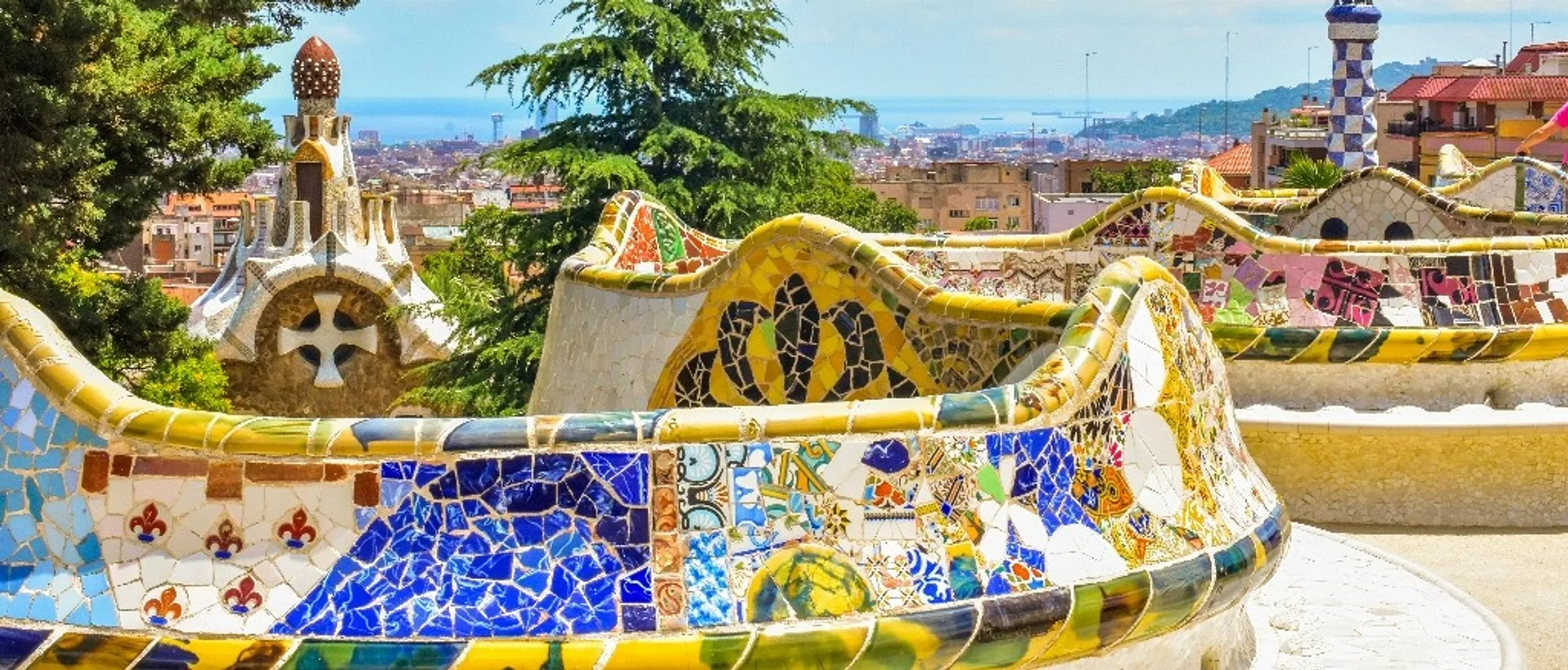
For the classic postcard view of multicoloured mosaicked terraces overlooking the city, Park Güell is where you need to go. When you visit, you’ll see natural shapes, textures, and coloured tiles throughout the gardens. Plus, a rather popular salamander.
Located in the Gracia neighbourhood, the closest metro station is Lesseps, which is a 20-min walk from the entrance.
At peak times and on weekends, the park does get fairly busy and tickets often sell out in advance. General entry costs €10, and we’d recommend purchasing your tickets at least a few days before you intend to visit.

Sign up for free to continue reading our Barcelona guide!
By signing up, you're agreeing to our privacy policy and terms and receiving deal alerts and travel related inspiration by email. This site is protected by reCAPTCHA and the Google Privacy Policy and Terms of Service apply.
Day trips
Since Barcelona is really well-connected by high-speed trains, it’s super easy for you to pop into another nearby city for a day or two, and explore some more of Catalonia while you’re there.
You can get to from here to loads of other cities across the country by train. But we’ve listed below a few of the best day trips that are all between a 30 mins-2 hours train ride away from the city, and won’t break the bank.
Costa Brava
Costa Brava runs along the northeastern coast of Spain, from the town Blanes right up to the French border. And with a name that means ‘Wild Coast’ in English, it won’t be too surprising to find out this region is filled with beautiful beaches, pine forests, and rugged rocky cliffs.
Dotted along the coastline, you’ll find plenty of traditional fishing villages, and seaside towns. Lloret de Mar is one of the more touristy places, with lots of resorts and hotels, but if you want something a little quieter, then somewhere like the medieval town Tossa del Mar is a great alternative.
Lots of people come to this coast for the beaches, but you can also do plenty of water sports like kayaking and snorkelling, as well as heading out on hiking routes, like the Camí de Ronda trail
Here’s a great guide to the region from a local’s perspective if you need a little more info.
Flight Finder Lauren's tip:
"If you're short on time and can’t make it to the Costa Brava, Castelldefels is a great alternative. It’s a laid back coastal town just south of Barcelona. It only takes around 25-minutes to reach by train and the fare is included in a HolaBCN and T-Casual card."
Girona
A little further inland from the Costa Brava, this city is much quieter than Barcelona, but with cobblestone streets, towering walls, and a centuries-old cathedral, it’s just as picturesque. You’ll start to see medieval influences as soon as you step foot in the historic center (which is around a 10-minute walk from the train station).
One of the most iconic spots here is The River Onya. It’s lined with colorful houses, which you can cross by walking over the Eiffel Pedestrian Bridge (yes, that Eiffel) to another side of winding, narrow streets.
And if you’re a fan of Game of Thrones, there are loads of filming locations from the series’ 6th season that you can spot. Here’s a guide to all the best spots with pics of the places in real life and on screen.
Zaragoza
Over in Spain’s Aragon region, Zaragoza is known for its Old Town, surrounded cathedrals and museums, as well as for being the home of Ternasco—this leg of lamb dish is famous all over the country, and lots of people call it a ‘jewel’ of Spanish cuisine.
And if you are a foodie, lots of restaurants and bars in the Juepincho area have offers that get you a tapas dish, and water, beer, or wine, for 2 euros! Find a list of some participating spots here.
For a little natural beauty, you should head to Monasterio de Piedra Natural Park. This monastery dates back to the 12th century, and is surrounded by a lush, green park filled with caves, crystal-clear lakes, and beautiful, fairytale-esque waterfalls.
If you fancy staying in Zaragoza for a little longer than a day, here’s an example itinerary for a 2-day trip.
Sitges
Stiges is a nearby coastal town and a firm favourite among locals who want to escape Barcelona for the weekend. You’ll have your pick of long sandy beaches with calm blue waters that are perfect for families. Its town is split between old cobbled streets lined with whitewash building and a modern, lively centre filled with bars and restaurants. It’s also considered a prominent gay capital, which hosts numerous LGBTQ+ events throughout the year.
You can reach Sitges by car or catch a train from Sants Station, with both options taking roughly 40 minutes.
Travel tip: Visit in February to watch the streets come alive during Sitges Carnival. It’s a 7-day event, full of parades, costumes and live music.

Montserrat
Montserrat is a picturesque rocky mountain range, where you can find a Benedictine Monastery nestled between huge, tall rocks. Aside from paying a visit to the abbey, you can also tackle one of the many hiking trails offering panoramic views of the Catalonian countryside.
The easiest way to visit is by train, which takes around an hour from Plaça Espanya to Montserrat town. Then it’s just a short cable car and funicular ride up to the top. Or, if you’re feeling brave, it’s a 1.5-hour upward hike.
There is a dedicated information booth in Plaça España station, where you can ask for advice and buy the train/cable car tickets. However, if you only want to take the train and plan to hike up to the monastery, it will be cheaper to buy your train ticket from the machines. You need to select a return journey from Zone 4, which costs €12.

La Molina Ski Resort
Not only is this Spain’s oldest ski resort, it’s also one of the most accessible from Barcelona at only 2 hours drive away. Home to over 61 runs of varying difficulty, ski newbies and snow pros can all have fun here.
For €67, you can buy a day-return ticket on the Sagales Skibus (departing from Nord bus station in Barcelona) and get a day ski pass included in the price.
You can bring your own equipment on the bus, if you happen to have it with you, or rent from the slopes once you're there.

Port Aventura
You can reach one of Europe's largest theme parks in just over an hour by car from the city. Alternately, you can also catch a train from Sants Station, which takes around an hour and a half. You can only buy your train tickets on the day directly from the station, so it’s best to arrive there early, especially during the summer.
You can sometimes find discount codes online that will save you some money off the entry fee. Otherwise, they usually run a 50% off sale on Black Friday.
